|
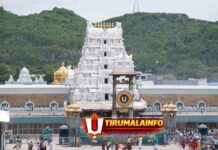
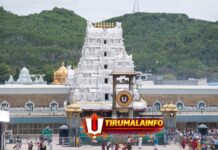
The ancient and sacred temple of Sri Venkateswara is located on the seventh peak, Venkatachala (Venkata Hill) ofSri Venkateswara Swamy against the backdrop of the Golden Vimanam the Tirupati Hill, and lies on the southern banks of Sri Swami Pushkarini.
It is by the Lord’s presidency over Venkatachala, that He has received the appellation, Venkateswara (Lord of the Venkata Hill). He is also called the Lord of the Seven Hills.
The temple of Sri Venkateswara has acquired unique sanctity in Indian religious lore. The Sastras, Puranas, Sthala Mahatyams and Alwar hymns unequivocally declare that, in the Kali Yuga, one can attain mukti, only by worshipping Venkata Nayaka or Sri Venkateswara.
The benefits acquired by a piligrimage to Venkatachala are mentioned in the Rig Veda and Asthadasa Puranas. In these epics, Sri Venkateswara is described as the great bestower of boons. There are several legends associated with the manifestation of the Lord at Tirumala.
The temple has its origins in Vaishnavism, an ancient sect which advocates the principles of equality and love, and prohibits animal sacrifice.
The sanctum sanctorum which houses the awe-inspiring idol of the Lord of the Seven Hills is situated in the main temple complex of Tirumala.
A statue of Raja Todarmul, a general of the Karnatak Nawab, and statues of his mother and his wife are found in a corner in the mandapam.
Next you come to the fully gold plated Dhwajastambham in a mandapam containing carvings of Avatarams.
From here you proceed to the inner gopuram on the inner prakara where you find to the left a small but beautiful shrine of Sri Varadarajaswamy. To the left of the shrine is the 'Potu' (kitchen) wherein a small shrine of Vakuladevi is located.
The next spot is the gold plated well in the vicinity of the Potu known as Bangarubavi As devotees proceed from this spot, the mood is suddenly heightened and surcharged with emotion. Shouts of 'Edukondalavada! Govinda! Govinda!' rend the air.
Now you are nearing the Bangaruvakili (the Golden Gate). As you turn into the Gate you find Lord Garuda in a take-off posture with wings spread to carry the Lord on his immense shoulders.
Immediately after this you are pushed towards the Dwaarapaalakas, sentries on either side of the Bangaruvakili, the entrance to the Sanctum Sanctorum. The long hours of wait and your inexhaustible patience bear fruit now as you are in the immediate presence of the Lord.
The first step, the entry into the Temple proper, is through the Mahadwaram on the East Mada Street. Upon entry through the Mahadwaram you come into the Pratima Mandapam where the statues of Sri Krishnadevaraya, Emperor of Vijayanagaram, and his two consorts are found. To the left is the 'Tulabharam', scales upon which materials are weighed against the devotees for being offered in the temple. There is a shrine of Sri Ranganatha in a Mandapam called Ranganayakula Mandapam where Vahanas of the temple are kept now.
The next point is the Tirumalanayaka Mandapam with beautiful carvings a little further into the temple.
There is ample literary and epigraphic testimony to the antiquity of the temple of Lord Sri Venkateswara.
Sri KrishnadevarayaAll the great dynasties of rulers of the southern peninsula have paid homage to Lord Sri Venkateswara in this ancient shrine. The Pallavas of Kancheepuram (9th century AD), the Cholas of Thanjavur (a century later), the Pandyas of Madurai, and the kings and chieftains of Vijayanagar (14th - 15th century AD) were devotees of the Lord and they competed with one another in endowing the temple with rich offerings and contributions.
It was during the rule of the Vijayanagar dynasty that the contributions to the temple increased. Sri Krishnadevaraya had statues of himself and his consorts installed at the portals of the temple, and these statues can be seen to this day. There is also a statue of Venkatapati Raya in the main temple.
After the decline of the Vijayanagar dynasty, nobles and chieftains from all parts of the country continued to pay their homage and offer gifts to the temple. The Maratha general, Raghoji Bhonsle, visited the temple and set up a permanent endowment for the conduct of worship in the temple. He also presented valuable jewels to the Lord, including a large emerald which is still preserved in a box named after the General. Among the later rulers who have endowed large amounts are the rulers of Mysore and Gadwal.
After the fall of the Hindu kingdoms, the Muslim rulers of Karnataka and then the Britishers took over, and many of the temples came under their supervisory and protective control.
In 1843 AD, the East India Company divested itself of the direct management of non-Christian places of worship and native religious institutions. The administration of the shrine of Sri Venkateswara and a number of estates were then entrusted to Sri Seva Dossji of the Hatiramji Mutt at Tirumala, and the temple remained under the administration of the Mahants for nearly a century, till 1933 AD.
In 1933, the Madras Legislature passed a special act, which empowered the Tirumala Tirupati Devasthanams(TTD) Committee to control and administer a fixed group of temples in the Tirumala-Tirupati area, through a Commissioner appointed by the Government of Madras.
In 1951, the Act of 1933 was replaced by an enactment whereby the administration of TTD was entrusted to a Board of Trustees, and an Executive Officer was appointed by the Government .
The provisions of the Act of 1951 were retained by Charitable and Religious Endowments Act, 1966.
|